
Start With Claremont's Residents Directory
A useful Claremont resident-record search begins by naming the fact that needs proof. An address points to the Los Angeles County Assessor, where an exact situs search or 10-digit AIN can identify a parcel. The record supplies legal description, values, exemptions, and transfer pointers, but the unrestricted web view may omit an owner name. The latest deed supplies recorded parties. For older work, directories, yearbooks, census schedules, maps, and obituaries add a date that a current parcel screen cannot.
Each source answers a different question. Ownership is not residence, a court party is not automatically a household member, and a college directory may describe one academic year. Keep those labels beside each result. The Claremont street directory workflow orders the parcel, deed, eligible street index, and reverse-directory steps.
- Start with the full name, address, institution, spouse, or other anchor already known.
- Search the Assessor by exact address or AIN, and save the displayed parcel and event fields with the retrieval date.
- Use the recording date and document number to move from the parcel event to the RR/CC deed or recorded instrument.
- Use the county court, vital, voter, business, license, or unclaimed-property route only for the purpose and record type it allows.
- For a past household, pair a directory or yearbook with a census, newspaper, obituary, probate file, map, or college archive.
Claremont's Resident Records Offices
Claremont is incorporated, but it is not a separate county records jurisdiction. Los Angeles County Registrar-Recorder/County Clerk, or RR/CC, handles recorded real-estate documents, vital copies, voter administration, fictitious business names, marriages, and notary filings. The Assessor supplies parcel evidence, the Superior Court supplies cases, and City Hall holds records created by Claremont, such as planning files, permits, and council material.
Access differs by office. RR/CC offers online copy ordering plus viewing and index work at county facilities. The Assessor portal supports address, AIN, and map work but limits public owner display. Elections allows personal registration checks, while a voter file needs a permitted purpose and contract. Start with the custodian, record type, name or address, and date range.
Los Angeles County RR/CC
12400 Imperial Highway
Norwalk, CA 90650
(800) 201-8999, options 2 and 3
Los Angeles County Assessor
Public parcel and map portal
Address or AIN search
Online portal and office inquiry
Los Angeles County Elections
12400 Imperial Highway
Norwalk, CA 90650
(800) 815-2666, option 4
The county's recorder and elections gateway sorts Claremont requests by service.
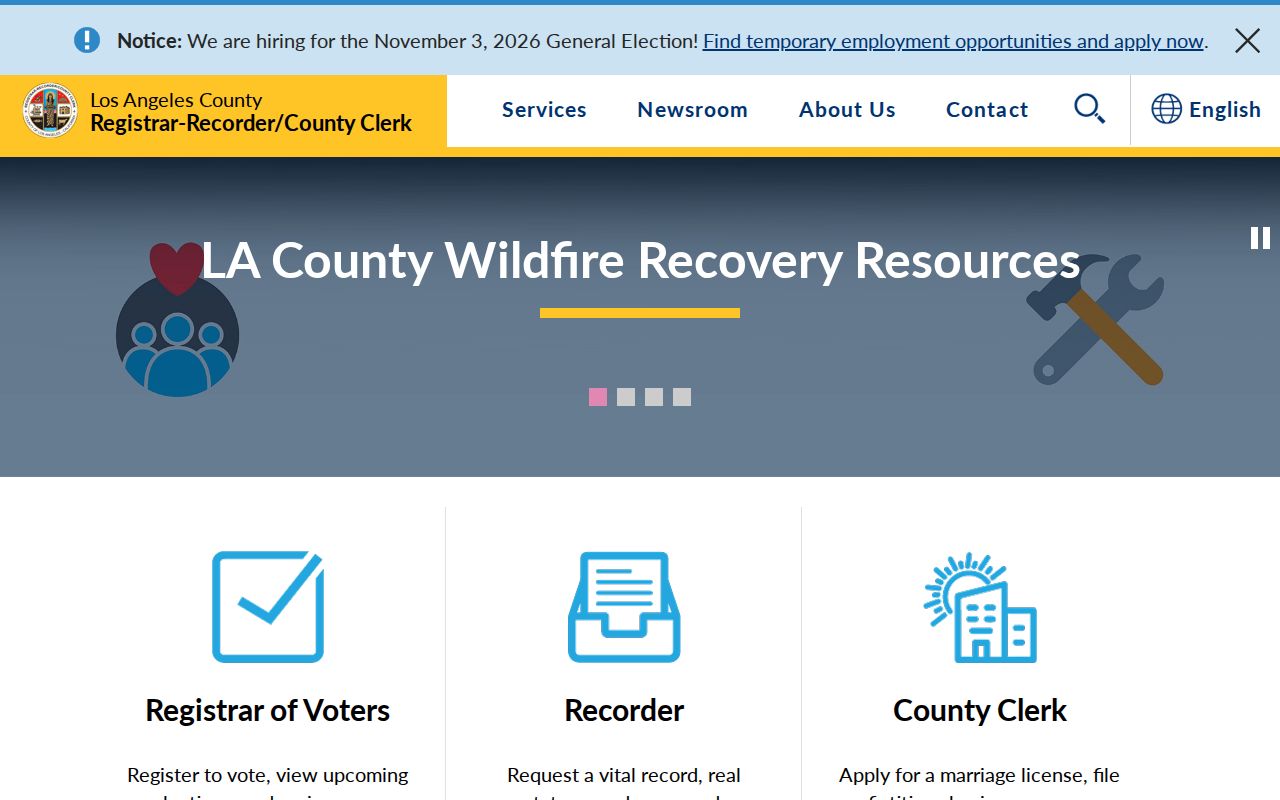
The gateway shows why a resident trail is split across offices: deeds, voter administration, vital certificates, and county clerk filings do not share one public search box.
From Name to a Claremont Address
A name-only result is a lead, not an identity. Start with a full name and one anchor such as a former address, middle initial, spouse, college, age range, business role, or case number. Search two custodians that did not copy from one another. For example, an Assessor parcel and a recorded deed may establish an ownership trail, while a directory or yearbook may place a person at an address during a particular period. A license or business filing can corroborate a public role, but it should be labeled as a professional or business address.
The strongest match uses two independent facts, such as the same spelling and address, a spouse and date, an institution and street, or a court record and parcel. Preserve spelling variants, initials, former surnames, and trust or entity names. Do not merge two people just because both records mention Claremont. A separate resident lookup keeps a one-person chain distinct.
Claremont Assessor Search Fields
The Los Angeles County Assessor Portal is a parcel index, not a household roll. It accepts an exact address or 10-digit AIN and offers a map mode. Detail can show situs, legal description, use, status, exemptions, values, and event history with recording date, document number, type, and reason. An unrestricted result may suppress the owner name, so a blank name is a visibility limit.
| Field label | Type | Required | Format or use |
|---|---|---|---|
| Search by AIN or Address | Text or autocomplete | One key | Use a 10-digit AIN or an exact street address and select the match. |
| Map Search | Map mode | No | Pan, zoom, and click parcel outlines to open detail. |
| Assessor Internet | Linked service | No | A secure or legacy route may require registration. |
| Show Re-Assessable Only | Checkbox | No | Filters the event and roll tables. |
| Hide Inactive Rolls or Show All | Checkbox | No | Changes which roll or event rows appear. |
If the portal omits the owner name, use the secure Assessor service, office inquiry, tax bill, deed index, or another lawful channel. Save the AIN, legal description, event number, and data-effective date. An exemption supports owner occupancy only when its type and tax year are verified; its absence proves nothing about occupancy.
The Assessor parcel search exposes the bridge fields needed for a deed request.
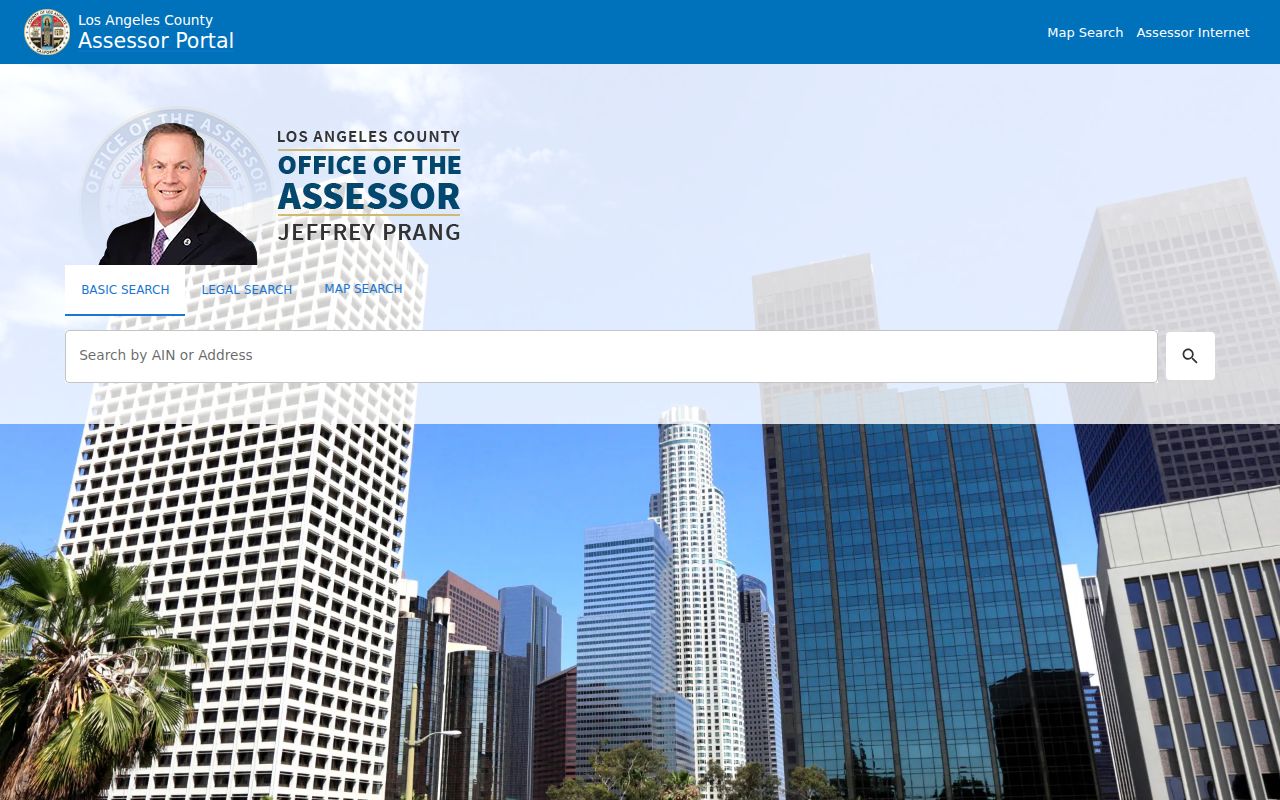
The parcel view can narrow a search to one AIN, but it cannot by itself supply a list of every person who lives at that situs.
Current Claremont Resident Directories
Modern resident evidence is spread across records with different roles. The property roll describes land, a court index a case participant, a city permit an applicant or contractor, and a college directory an affiliation. None is a complete household directory. The table keeps source, keeper, and access limit together.
| Source | Who or what it identifies | Keeper | Access |
|---|---|---|---|
| Assessor parcel and tax evidence | Situs, AIN, legal description, values, events | Los Angeles County Assessor | Free portal; owner channel varies |
| Recorded-document index | Grantors, grantees, liens, releases, maps | RR/CC | Viewing, copy order, counter, or request route |
| Voter self-lookup | A person's own registration and election information | LA County Elections | Self-verification only |
| City files | Applicants, contractors, cases, public correspondents | Claremont departments | Department inquiry or CPRA request |
| College and professional directories | Academic or public work affiliation | Colleges, state boards, or agencies | Collection or board rules |
These four terms keep a Claremont resident-record search from blending unlike records.
- Roll
- An assessment or tax list arranged around parcels, values, or status, not a household list.
- Index
- A finding aid with names, parties, dates, or document numbers pointing to a record.
- Criss-cross directory
- A reverse directory arranged by street and house number, with an occupant when held.
- Parcel
- A legally tracked land unit identified by an AIN, situs, boundaries, and legal description.
Use each source for its question. RR/CC may confirm a transfer, a directory an occupant at a date, and a business filing an agent or mailing address. A self-lookup confirms the submitter, not a neighbor. These labels keep the Claremont record trail accurate.
The Claremont Deed Trail Starts in 1850
Los Angeles County RR/CC states that its real-estate holdings begin in 1850, before the named Claremont townsite. The online copy page routes orders through LexisNexis and states 20 working days. Use the Assessor event row for recording date and document number, then choose RR/CC viewing, counter help, index, or copy service. Older work uses grantor and grantee names, year, document number, and book or page when supplied.
Grantor transfers an interest; grantee receives it. A deed of trust records financing, while a reconveyance releases a security interest. Legal description controls when a street, number, tract, or parcel changes. Match it with AIN history before treating documents as one trail.
The RR/CC viewing instructions explain the in-person channel for readers who need to inspect the index or document path rather than begin with an online copy order.
Claremont Court Names and Case Numbers
Claremont cases belong to the Superior Court of California, County of Los Angeles. Case-number access is free, while party or defendant-name searches are paid. The civil party index covers unlimited civil, family, and probate matters from 1983, limited civil from 1991, and small claims from 1992. Criminal searches can show case number, filing date, charges, or disposition when public. Federal matters use the Central District of California through PACER.
A case-number search and paid name search answer different questions. The portal may offer a calendar or eligible document image. Images cost $1 per page for the first five, then $0.40 per page, with a $40 maximum. Criminal and family images are generally not remote. Courthouse terminals and clerk requests remain fallback channels. A name hit needs another anchor such as middle initial, date, filing location, counsel, or address in a filing.
Use the Los Angeles Superior Court case search for the index and the court's fee information for current access costs.
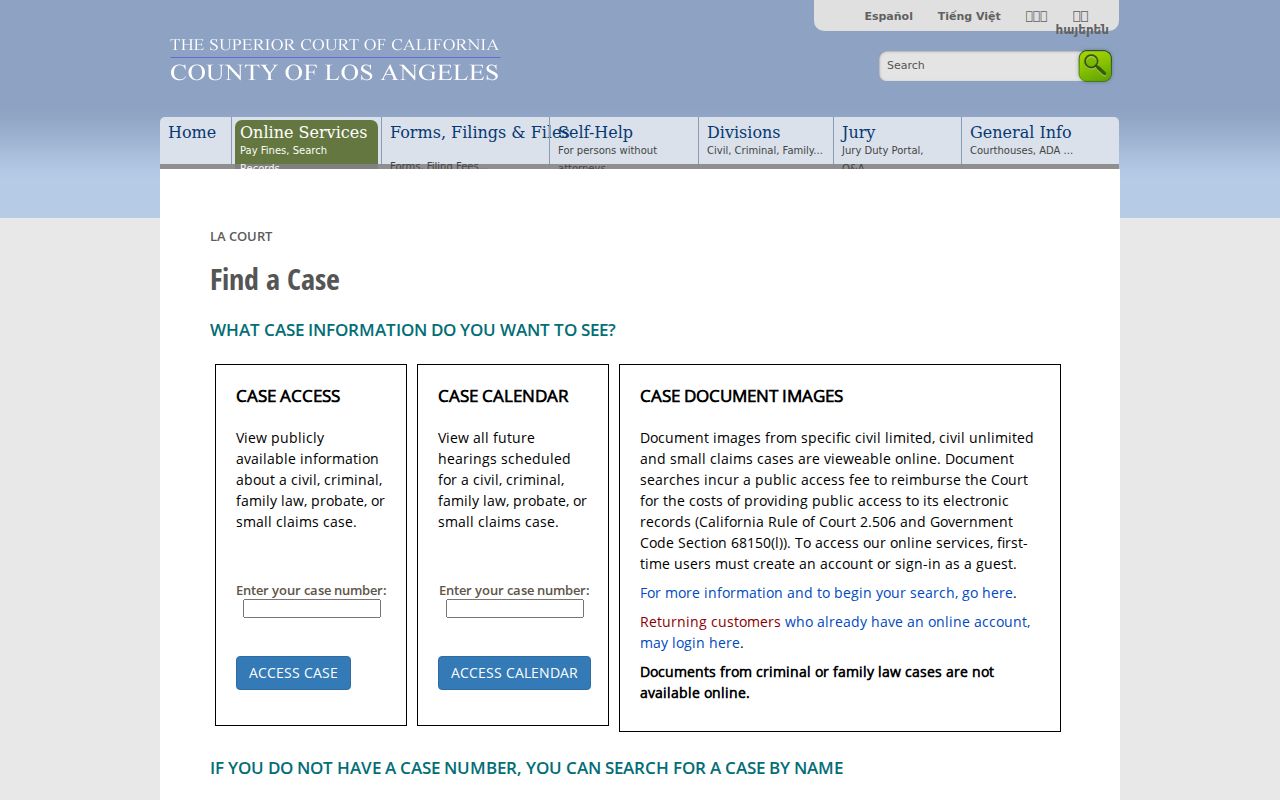
The court screen is a case gateway, not a public list of every Claremont resident, and sealed, juvenile, family, and confidential records have separate limits.
California Voter Data and Claremont Addresses
California voter data has a legal gate in a Claremont resident-record search. The county's Find My Election Information service lets a person check their own registration and election details. It is not a public name-and-address directory. Elections Code section 2194 permits voter information for election, scholarly, journalistic, political, or governmental purposes, with a signed contract and conditions. Personal, private, and commercial use is barred. Social Security numbers, driver's-license numbers, and signatures remain confidential.
Eligible requesters can order county, city, district, or precinct data through the voter-information route. The county lists $146 for countywide information, $54 for precinct, district, or city information, and $39 for an additional file. The Index to Voter, also called the Street Index, has separate per-thousand or per-page prices based on the requester and permitted political purpose. Requests go by mail or in person to Election Information, second floor, room 2013, 12400 Imperial Highway, Norwalk, and the documented phone route is (800) 815-2666 option 4.
A missing name can reflect a move, update delay, inactive or cancelled status, formatting, or a confidentiality flag. It is not proof that a person does not live at an address. The public self-check and the restricted street index belong in different parts of the Claremont record trail.
Vital Records and Claremont Copy Types
Los Angeles County RR/CC issues county birth, death, and marriage copies, while California Department of Public Health Vital Records maintains the statewide system. A certificate search and certified copy are different. Authorized copies require an eligible relationship, purpose, court order, or other statutory route. Informational copies have another access level and cannot establish identity. Confidential marriage records remain restricted under Family Code sections 509 through 511.
The 2026 schedule lists $31 for birth, $26 for death, $19 for marriage, and $18 for dissolution. A search fee remains due when no record is found. Current CDPH forms ask for applicant, event, names, date and place, relationship, purpose, copy type, sworn statement, signature, and payment; mailed authorized requests can require notarization.
A divorce certificate is not the Superior Court judgment. Adoption records are confidential, and reunion routes depend on consent and relationship. California has no single age threshold that opens every vital certificate. Historical indexes are discovery tools, not blanket access to modern copies.
The California vital-records service identifies the statewide custodian and current application routes.
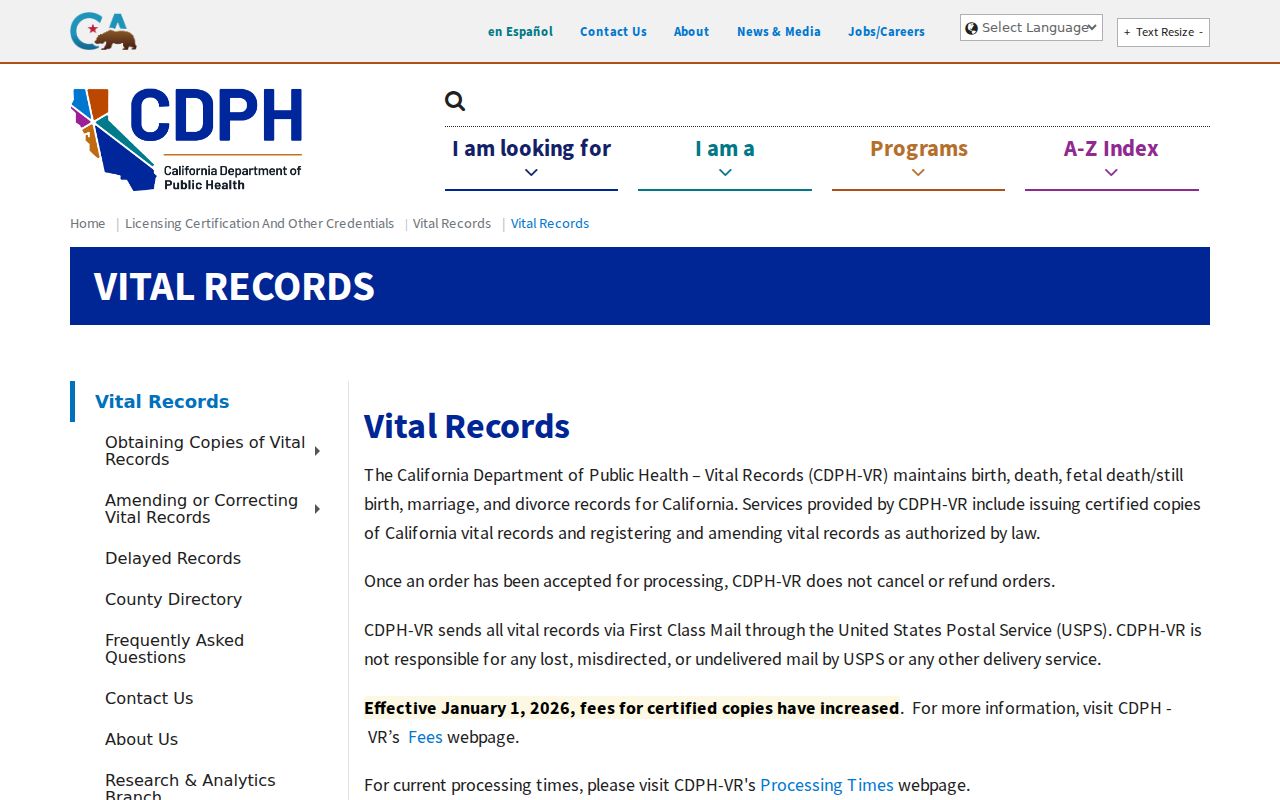
The application list helps separate a historical index clue from the copy request that can legally confirm an event.
Historical Claremont Directories and Archives
Claremont's historical resident trail is unusually strong because several repositories preserve records outside the county portals. The Claremont Colleges Library identifies Claremontiana, city directories, maps, newspapers, photographs, ephemera, manuscripts, and local histories. College catalogs, yearbooks, handbooks, organization scrapbooks, faculty papers, oral histories, and campus plans can place a person at an institution even when a property roll does not. Scripps materials have a separate home in Denison Library. Search both the shared library and the relevant college archive.
A college directory entry is not automatically a permanent Claremont residence. A student may appear for one academic year. A faculty or staff record may show a campus role and a public work contact. A campus parcel may use an institutional delivery point. For a classmate search, start with yearbooks and catalogs, then compare the name, academic year, organization, and any known address with a public professional or organization record. The historical collection is best treated as a dated affiliation layer.
The Claremont city directory collections add the broader historical shelf, while college archives explain the institution-specific trail that ordinary city volumes may miss.
A Narrow Claremont CPRA Request
When a portal stops short, ask for an identifiable existing record, not a list staff would need to create. The Claremont City Clerk public-records route fits council material, planning cases, permits, code files, contracts, and departmental records. State the street, parcel if known, record type, department, subject, and date range. Ask for an existing permit application, card, inspection chronology, or final approval.
The California Public Records Act, Government Code sections 7920.000 and following, generally calls for a determination within 10 calendar days, with a possible 14-day extension. Inspection is ordinarily free, while duplication or specialized statutory fees can apply. Exempt material may be redacted, and building files may withhold personal contacts, copyrighted plans, security details, or active enforcement material. Deeds, voter files, court cases, and vital certificates belong with their own custodians; the RR/CC CPRA route does not replace the special real-estate process.
Check Two Claremont Identity Anchors
Official records and commercial compilation services serve different purposes. A county or state custodian states what its record means, when it was created, and what access rule applies. A commercial compilation may merge public, licensed, and inferred data from many places. It can be a lead, but it may be stale, join two people with the same name, or lack a clear correction path. Neither type should be treated as proof until the original custodian confirms the material fact.
| Route | Strength | Limit | Best next check |
|---|---|---|---|
| Official parcel, deed, court, or vital record | Named custodian, defined fields, record date | Access, redaction, and eligibility rules apply | Read the original record or ask the custodian |
| Official library, college, or yearbook source | Dated affiliation, address, occupation, or context | Collection gaps and academic-year limits | Pair with a census, deed, obituary, or later source |
| Commercial compilation | May surface spelling or address leads | Mixed sources, stale data, unclear provenance | Verify every key fact at its source office |
Two independent anchors can be a matching address and spouse, an AIN and legal description, or a yearbook affiliation and a dated public record. Keep owner, occupant, agent, applicant, mailing recipient, and case participant as separate labels. That small discipline prevents a fast Claremont identity search from becoming a false match.
Claremont Protected Addresses and Privacy
California privacy rules shape what a resident search can reveal. Safe at Home, under Government Code section 6205 and following, gives qualifying survivors and specified protected people a substitute mailing address, mail forwarding, and confidential voter registration. Voter files suppress protected registrations. Recorded documents use redaction and petition mechanisms for sensitive identifiers rather than blanket deletion.
The California Consumer Privacy Act and California Privacy Rights Act give covered consumers rights to know, access, delete, correct, and opt out of sale or sharing, subject to exemptions. Use official privacy guidance for current deletion procedures. DMV information remains closed under the federal Driver's Privacy Protection Act and California law without a permitted use.
Lawful use. Claremont records are for personal, lawful research. Do not use an address, voter, court, or property trail to stalk, harass, intimidate, or harm another person.
The Safe at Home program and the county voter rules should be checked before drawing conclusions from a missing name or address.
The 1887 Claremont Townsite Trail
Claremont's records make more sense when town and county history stay together. Los Angeles County was created in 1850, and RR/CC holdings start there. Claremont was laid out in 1887 after the Santa Fe route opened. The Pacific Land Improvement Company mapped a railroad town, and a failed hotel scheme left the hotel available to Pomona College, whose 1888 move gave the town an institutional anchor. An old address can pass through Rancho San José land, a company tract, a college parcel, and later subdivisions.
Early citrus planting, packing houses, water companies, photographs, newspapers, and business records add residents who may not appear as parcel owners. After World War II, growth peaked at more than 1,500 added residents each year during 1960-1965. Groves became new parcels, so plats, permits, Assessor events, Sanborn maps, and directories must be read together. That is why the Claremont record trail is linked evidence: preserve the source, date, and role beside every name.