
Where Claremont Directory Collections Live
No official source publishes a clean, year-by-year list of every Claremont volume or a verified publisher sequence. The strongest route is repository-led. The coverage table records what the research actually establishes, while leaving the local publisher and sample-entry gap visible.
| Collection | Years or span | Where held | Access |
|---|---|---|---|
| LA County Library Californiana city directories | Dating from the 19th century; exact Claremont runs not cataloged in overview | Norwalk closed stacks | Catalog and reference request; supervised use |
| California census schedules | 1850-1910 | Californiana Collection | Closed stacks; pair with directories |
| Claremontiana and local history | Late 19th century onward, collection-specific | Claremont Colleges Library Special Collections | Catalog, finding aids, digital objects, appointment |
| College yearbooks, catalogs, directories, and handbooks | Institution-specific runs | Claremont Colleges Archives and Denison Library | Catalogs and in-house inventories |
| Digital Sanborn Maps: California | Database span 1867-1970 | Claremont Colleges Library | Licensed institutional access |
| Maps, plans, and historic photographs | 1888 townsite onward, collection-specific | Claremont Heritage, LA County Library, and TCC | Digitized samples or archival request |
Exact title-page year, geographic scope, canvass date, and publisher must be captured from the volume supplied by staff. A regional Pomona Valley or Los Angeles directory may contain Claremont even when the city name is absent from the title.
Four Claremont Repositories for Names
The LA County Library Claremont Local History collection gives the local narrative, historic image gallery, and reference route. Its deeper Californiana Collection is at Norwalk Library, where closed stacks contain more than 24,000 books, over 200 magazine and newspaper titles, California census schedules, nineteenth-century directories, and local histories. A branch researcher should ask about cataloged directories, microfilm, newspaper access, and inter-branch procedures before travel.
The Claremont Colleges Library Special Collections adds Claremontiana, maps, manuscripts, newspapers, photographs, ephemera, and printed histories. Its discovery system separates Library Search, ArchivesSpace and Online Archive of California finding aids, and the Claremont Colleges Digital Library. Denison Library holds Scripps College archives separately. Claremont Heritage supplies a local-history and photograph channel, while National Archives at Riverside can supplement federal records.
Repository boundaries matter. An archive finding aid can identify boxes and folders without indexing every resident. Search the collection creator, organization, tract, institution, and date span as well as a surname.
The county library's local-history page shows how a Claremont directory search can extend beyond a name index.
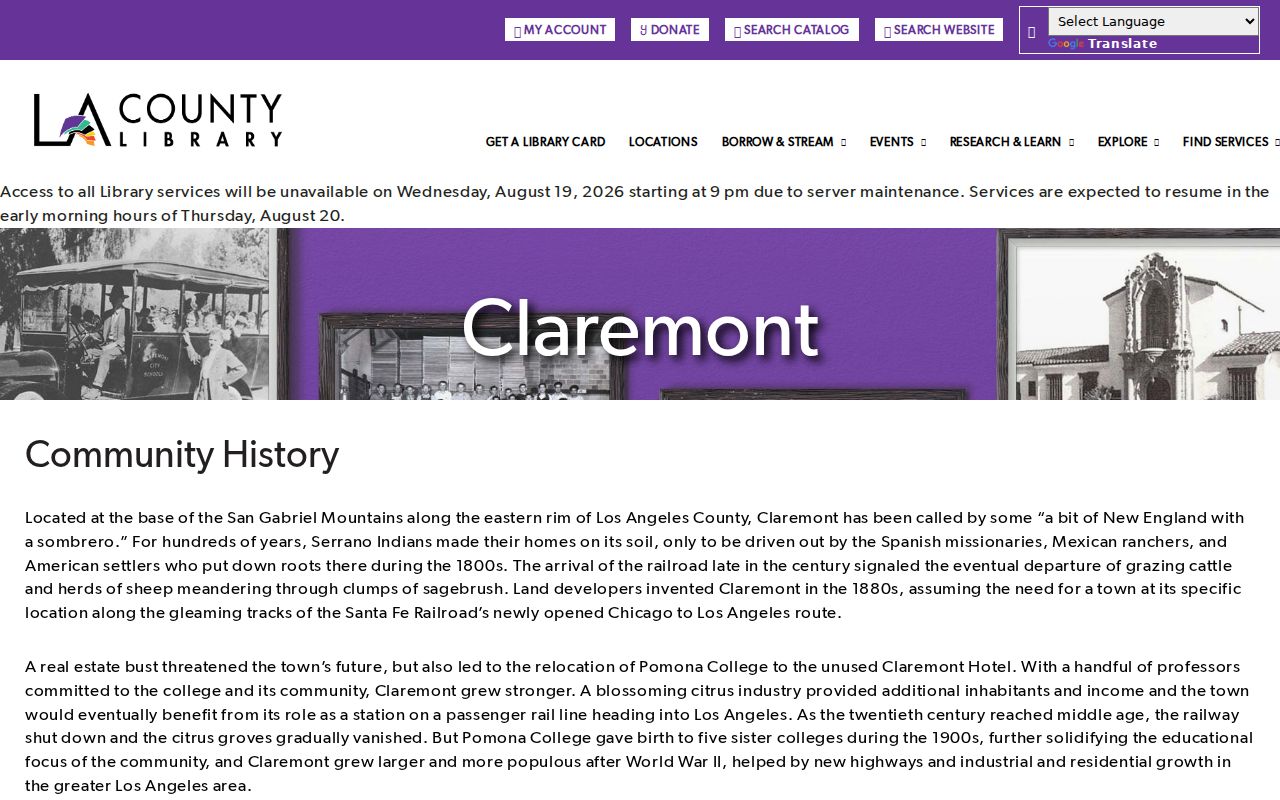
The local-history layer supplies context for streets, institutions, citrus land, and community images that a printed directory may not explain.
The Californiana Claremont City Directory Shelf
The LA County Californiana Collection is the principal shelf for the broader historical search. Its public description identifies nineteenth-century city directories, California census schedules from 1850 through 1910, the Los Angeles Star from 1851 through 1879, newspapers, and official histories. The collection is closed stack, so a catalog search and a reference request come before an in-person visit. Ask staff to check the subject headings `Claremont (Calif.)--Directories`, `Pomona Valley--Directories`, telephone directories, county directories, and local histories.
Directory gaps are meaningful only after the collection scope is known. A missing Claremont title may reflect a regional title, a volume not yet cataloged, a nonannual run, or a page that is not digitized. Library staff can explain retrieval, appointment, scanning, camera, and inter-branch limits. Do not convert an overview that says “dating from the 19th century” into an invented first year or last printed year.
The Californiana description also makes a useful pairing possible: use a directory for address and occupation, a census for household relationship, and a newspaper or obituary for a move or death clue.
The Californiana search route is shown through its official local-history and genealogy description.
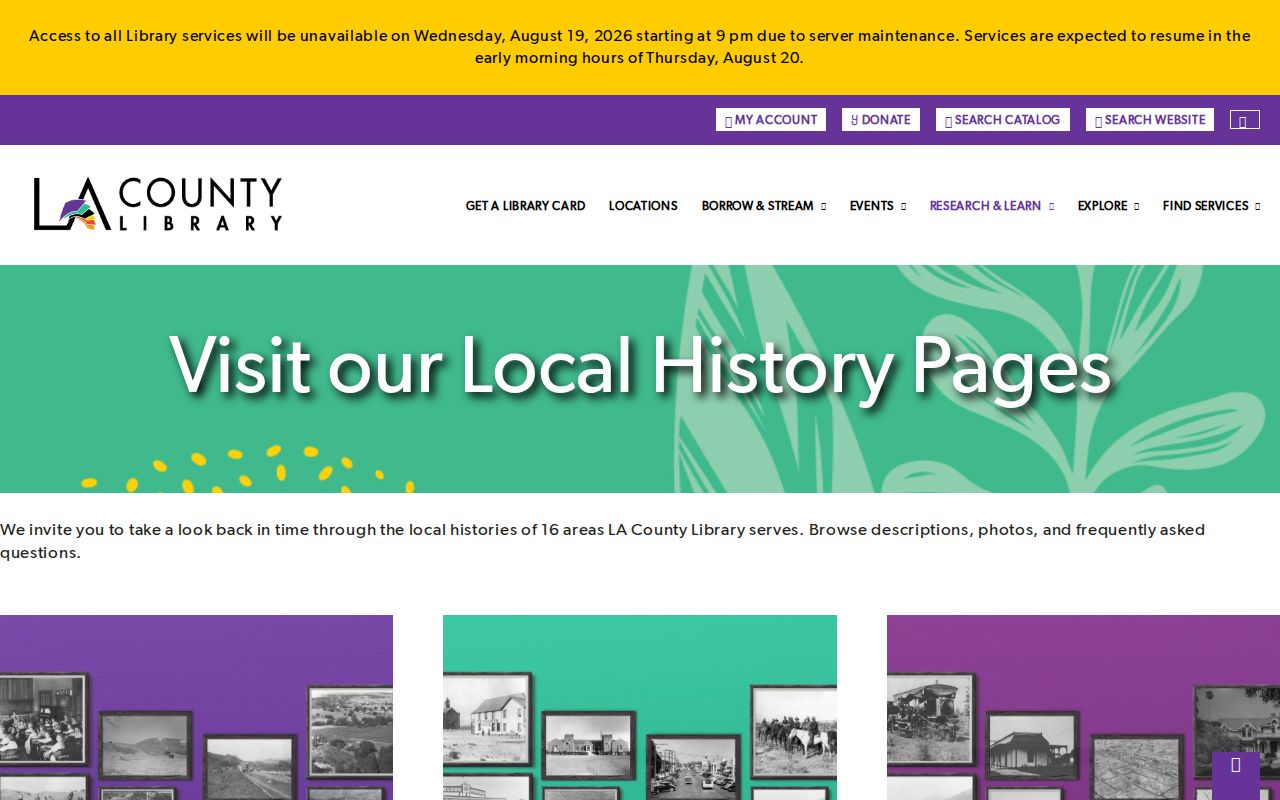
A shelf image is a reminder to cite the repository and catalog scope, not just a transcription copied from an unknown source.
Claremontiana and the College Archives
Claremontiana extends the historical directory search into college catalogs, yearbooks, organization scrapbooks, faculty papers, oral histories, maps, plans, and campus publications. Named holdings include the Woman's Club of Claremont Records, the Padua Hills Theatre Collection, citrus and orange collections, and Western Americana. These materials can identify a civic participant, student, grower, performer, or college worker who never appears as a parcel owner.
Claremont Heritage, at 590 W. Bonita Avenue, is a local-history and photograph contact. The research records its phone as (909) 621-0848. Ask for image captions, donor or provenance notes, date confidence, historic structure context, and the source of an 1888 townsite brochure map. A photograph can place a street or building in time, but an undated label should not be treated as a verified directory entry.
College archives and public libraries answer different questions. A directory at TCC may be a published volume. An institutional archive may hold a catalog or roster that needs staff help. Denison materials should be requested through Scripps' repository route, while shared college holdings use the TCC catalog and finding aids.
The Claremont Heritage archive channel shows the local setting behind the printed collections.
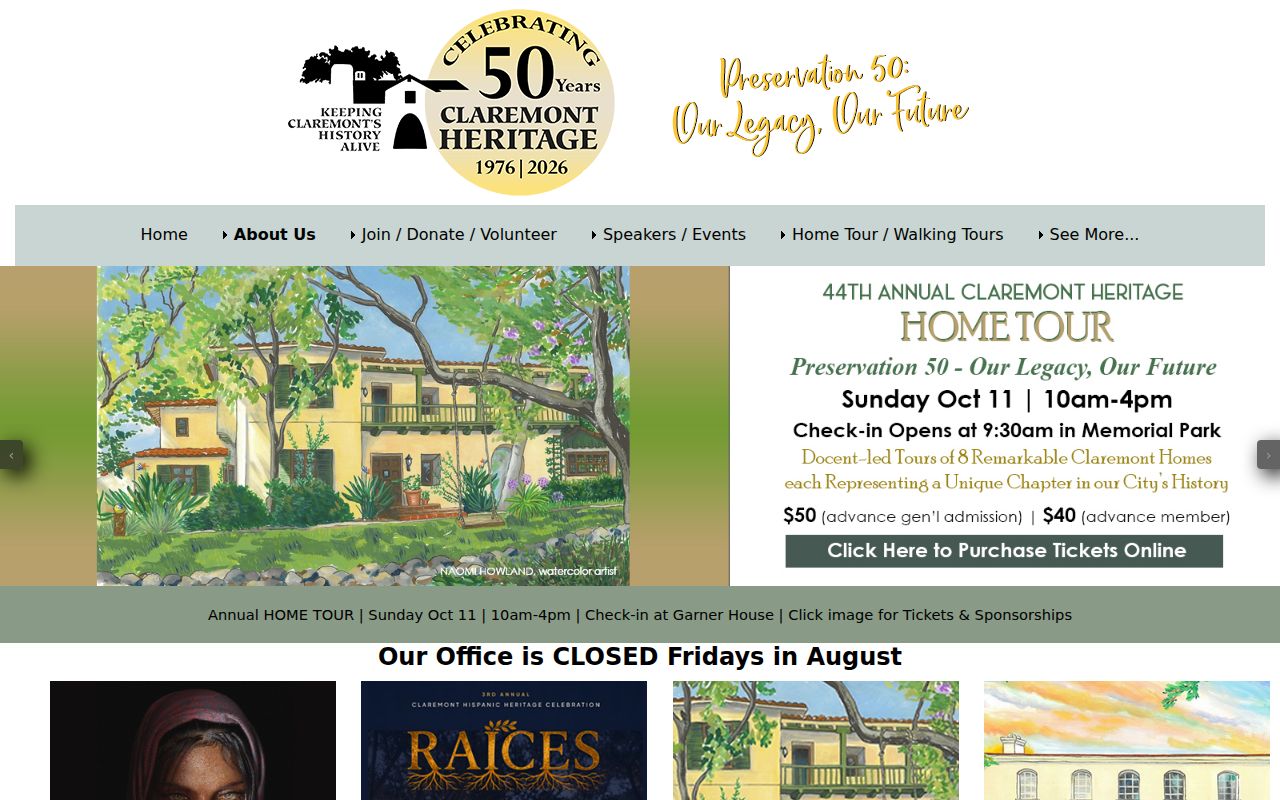
Historic photographs and maps can test whether a street number, tract, or building name remained stable across directory years.
Read a Claremont City Directory Entry
No authoritative source exposed an actual Claremont or Pomona resident entry with a verified publisher and year during the research run. Do not invent a sample name, volume, publisher, or year. When staff supplies a volume, capture the title page, copyright year, geographic scope, front-matter coverage statement, street section, alphabetical section, and abbreviation key before copying one entry.
| Name | Printed surname, given name or initial, and spouse in parentheses when shown. |
|---|---|
| Occupation | The occupation printed in that run, without assuming it is current. |
| Address | House number and street, with the volume's own residence or boarding abbreviations. |
| Business address | An employer or work address when printed, kept separate from the home address. |
| Owner or renter mark | Use only when the volume explains a symbol or letter for that role. |
| Telephone or cross-reference | Copy the printed telephone, widow notation, or cross-reference and link it to the abbreviation key. |
- Criss-cross directory
- A reverse section arranged by street and house number, then occupant or telephone when supplied.
- Householder index
- An alphabetical or name-based index that points to the household listing or address section.
- Abbreviation key
- The volume's explanation of short forms and symbols. Photograph it before interpreting an entry.
- Coverage statement
- Front matter that says which places, dates, or canvass period the volume includes.
Reverse Directories by Claremont Street
A reverse directory changes the order of the search. Instead of starting with a surname, start with a street, house number, and edition date. Record nearby numbers as well as the target because a skipped parcel, institution, or changed address can explain a gap. Then compare the entry with an Assessor legal description, a townsite or subdivision map, and a census or newspaper from a close year.
The exact Claremont reverse-directory years remain unverified in public collection descriptions. A reference librarian may locate a regional Pomona Valley or Los Angeles volume, a telephone directory, or a criss-cross section in a broader directory. Preserve title, publisher, copyright year, canvass date, page, street spelling, and abbreviation key. An absent name can mean an unlisted phone, missed canvass, student or institutional residence, late arrival, limited scope, missing pages, or a nonannual publication. The modern address chain belongs on the Claremont street directory route.
College Yearbooks and Academic-Year Claremont Residents
Yearbooks, catalogs, handbooks, and college directories are a strong human-use route for reconnecting with a Claremont classmate. Start with the school and academic year, then record the printed name, class, organization, residence or campus reference, and any caption. Search the shared TCC holdings and the relevant college archive. The Claremont Colleges history includes Pomona's 1888 relocation, Scripps in 1926, Claremont Men’s College in 1946, Harvey Mudd in 1955, and Pitzer in 1963 or 1964, so an institution and year can narrow a name before any modern record search.
Academic affiliation is not permanent residence. A student can be listed for one year and then leave. A faculty or staff entry may be a public work contact. A campus mailbox or central delivery point may not describe the parcel where a person lives. Compare the yearbook with a later directory, professional record, obituary, or institutionally published contact, while keeping the date and role explicit.
Trace a Household Through Claremont City Directories
A household trail works best when directory years are paired with census years, not when a single entry is treated as a full life story. The 1950 federal census is the newest public population schedule under the 72-year rule as of 2026. A directory can fill the years between decennial schedules, while a deed, permit, map, obituary, or probate record tests whether the household moved, changed form, or only appeared under a different spelling.
- Choose a known household and a census year, then locate the closest directory edition.
- Copy exact spelling, spouse notation, occupation, address, owner mark, and edition details.
- Move one edition at a time and record every street or number change.
- Use a criss-cross section to test nearby names and address continuity.
- Check an obituary, death index, probate file, newspaper, or later directory before interpreting a disappearance.
Disappearance can mean a move, death, an unlisted telephone, a canvass gap, a name under a spouse, a student term, or a geographic cutoff. Two or three consecutive editions are stronger evidence than one. For a court, deed, or current person question, a directory result should be verified with the source custodian rather than copied into a modern resident list.
Claremont Directory Timeline and Research Gaps
The available timeline explains the setting without pretending that an unverified publisher sequence exists. Each item is a research anchor that can guide a request for the actual volume.
- 1850: Los Angeles County real-estate holdings begin in the RR/CC record history.
- 1887-1888: the railroad townsite and Pomona College's move create early land and institutional trails.
- 19th century onward: the Californiana overview identifies city directories, but exact Claremont runs remain a catalog question.
- 1867-1970: the Digital Sanborn Maps database span can add building footprint and street context where the Claremont sheet is available.
- 1950 and after: the public census cutoff and later directory gaps make yearbooks, newspapers, and local archives more important.
The National Archives at Riverside can supplement federal court, immigration, naturalization, land, agency, and census research. Cite the schedule, enumeration district, sheet, and household, not only a transcription. Digital Sanborn access is listed through the TCC Library databases page and may require institutional access.
The National Archives channel shows how a Claremont local-directory question can widen into a federal record search without losing the local date and address.
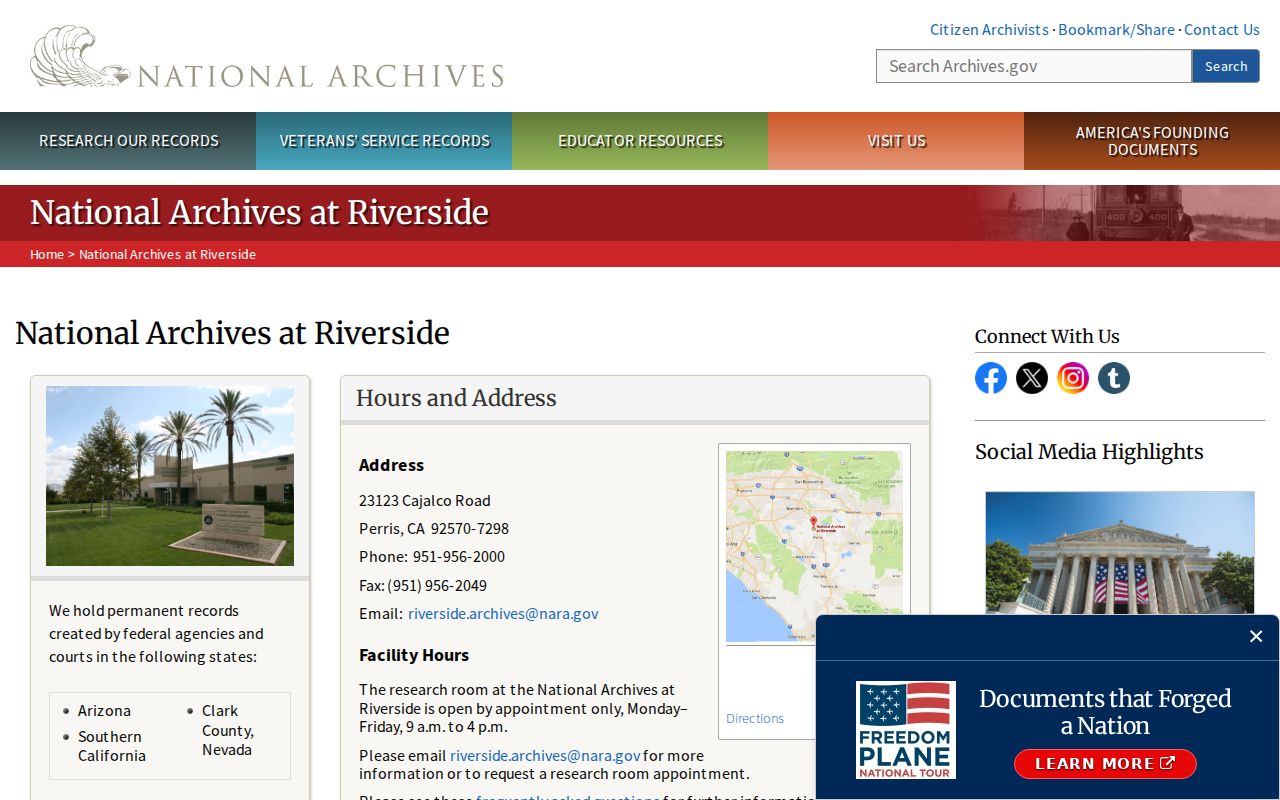
Federal records supplement the local shelf; they do not fill the unverified publisher and year gap by themselves.