
Claremont House-History Sources by Era
A reliable previous-residents search pairs each source with the question and time span. Deeds establish transfers. Directories and census add household evidence. Maps explain the parcel, while permits, newspapers, obituaries, and probate connect people to change or endings.
| Source | Years It Covers | Where Held | What It Shows |
|---|---|---|---|
| Recorded real estate | 1850 to present county holdings; channel varies | Los Angeles RR/CC | Grantors, grantees, legal description, recording data |
| Assessor parcel history | Current roll and displayed event history | LA County Assessor Portal | AIN, situs, values, transfer-event pointers |
| City directories and reverse directories | Nineteenth century onward in regional collections; exact Claremont runs vary | LA County Library and Claremont Colleges archives | Occupants, occupations, addresses, household clues |
| Federal census | 1850 to 1950 public schedules | NARA and library genealogy databases | Households, relationships, occupation, enumeration place |
| Sanborn maps | California database span 1867 to 1970 | Claremont Colleges Library | Building footprint, use, street and lot context |
| Permits and planning files | Exact public digitization cutoff not located | City of Claremont | Applicants, contractors, scope, dates, inspections |
Begin with the row that matches the date. A current parcel can lead to a deed; a known household year can lead to a directory and census pair. If the web stops, library staff, a counter, an archive appointment, or a narrow request can carry the search farther.
The RR/CC public-records request channel is the source for the county request guidance shown in this Claremont previous residents workflow.
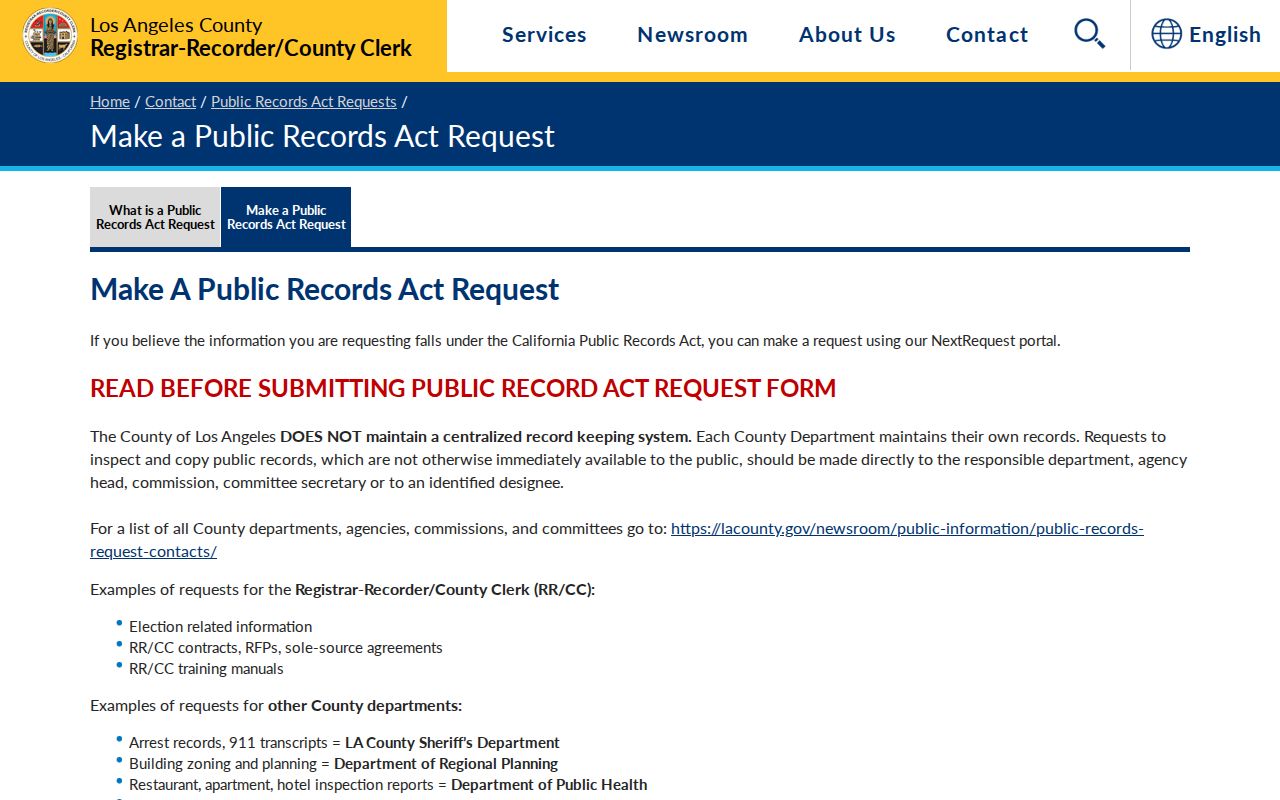
A county request can help locate an existing record, but it does not require staff to build a new list of past households. Name the address, parcel, record type, and date range instead.
The 1850 RR/CC Start Point
Los Angeles County’s Registrar-Recorder/County Clerk states that real-estate holdings begin in 1850. That date predates Claremont as a named town, so an early chain may pass through Rancho San José land, later subdivisions, and land-company transactions before a modern street address appears. The online copy page routes buyers to LexisNexis and states that orders are processed within 20 working days.
The research path is not limited to an online order. RR/CC provides in-person viewing of recorded real-estate documents, counter assistance, and a copy process. The Norwalk office is at 12400 Imperial Highway, Norwalk, California 90650. Recorder contact options include (800) 201-8999, option 2 for recording and option 3 for recorded real-estate records, plus recorder@rrcc.lacounty.gov. Use the document number, recording date, party names, and legal description to ask for the right instrument.
Fees vary by document, page, certification, and vendor. A grant deed, quitclaim, probate transfer, reconveyance, and deed of trust carry different meanings. Read the instrument before turning an event code into a resident claim.
Start Claremont History With AIN
The Assessor Portal is the cleanest starting point for a modern parcel. Search by exact address or 10-digit AIN, select the match, and copy the situs, legal description, parcel status, building details, values, and event row. The event row can show recording date, document number, document type, and document reason. It is the bridge from parcel research to a Recorder request.
The public sample can suppress an owner name. That is a limitation, not a blank to fill with guesswork. An Assessor inquiry, secure registered service, tax bill, or properly available deed may be needed for ownership evidence. A situs address is the physical parcel. A mailing address is where tax correspondence goes. A difference can reflect a trust, business, mailing agent, or nonoccupying owner.
Save the AIN, displayed roll year, retrieval date, and legal description. If a parcel split, combination, tract change, or old map affects the chain, legal description continuity is stronger than a street spelling that may have changed.
Trace Claremont Deeds Backward
A previous-residents deed trail moves from the current parcel to earlier grantors and grantees. The street address is only the starting label. The legal description, AIN history, recording number, and party roles control the match.
- Pull the current AIN, situs, and legal description from the Assessor record.
- Read the newest event row and request the corresponding deed or recorded instrument from RR/CC.
- Identify the current grantee and prior grantor, then search the prior owner as an earlier grantee.
- Match each older instrument by legal description, tract, map, or parcel history, not by street name alone.
- When the online route ends, move to RR/CC viewing, counter records, older books, or a focused copy request.
- Grantor and grantee
- The grantor transfers an interest; the grantee receives the interest named in the instrument.
- Chain of title
- The linked sequence of recorded transfers used to trace an interest backward.
- Legal description
- The recorded parcel language that identifies the land more reliably than a changing street label.
- Reconveyance
- A release of a security interest, not proof of a new occupant or ownership transfer.
Trust names, interspousal transfers, tax deeds, quitclaims, and probate instruments need their own context. A deed of trust identifies financing parties; it is not the same as a grant deed.
Ownership and Occupancy Split in Claremont
Ownership and occupancy are separate timelines. A deed can identify a grantee while a directory identifies a household member, renter, student, or caretaker. The Assessor can show situs and tax fields, but a property roll is not a complete occupant register. Mailing information is evidence of correspondence, not proof that the recipient slept at the parcel.
For each date, label the record as owner, occupant, applicant, contractor, mailing recipient, student, or organization contact. Avoid carrying a modern owner backward into a directory year without a matching source. Likewise, an old directory entry does not establish present residence.
Claremont’s colleges create a second caution. A student or faculty member may appear in a college directory for one academic year while living in an institutional setting. Campus archives, yearbooks, and catalogs should be dated separately from permanent household evidence.
Sanborn Maps Follow the Claremont Building
Digital Sanborn Maps for California span 1867 through 1970 in the Claremont Colleges Library’s licensed database. A Sanborn sheet can show a building footprint, use, construction material, lot edge, street name, and number context. It can explain why a current parcel has no early directory match or why an address needs a tract-map bridge.
Sanborn maps do not name every household. Pair a sheet with the deed chain, a city directory, census schedule, permit file, photograph, or newspaper. Use the map’s title, sheet number, date, and geographic scope, then keep the mapped building date distinct from a person’s move-in date.
The TCC Sanborn database is institutional and may require campus access, staff help, or an appointment. Claremont Heritage and LA County Library can add photographs and townsite context when a map leaves the building story unclear.
Past Households in Claremont Directories and Census
The household layer is where previous residents become more than a chain of owners. LA County Library’s Californiana Collection includes California census schedules from 1850 to 1910, nineteenth-century directories, newspapers, and local histories. The Claremont Colleges hold directories, yearbooks, catalogs, maps, manuscripts, and oral histories. Exact Claremont and Pomona publisher runs were not exposed on the public overview, so record the title page and coverage statement when staff supplies a volume.
- Choose a known household date and write down the exact street, number, surname, spouse, and occupation.
- Check the nearest alphabetical or reverse directory, noting the title page, publisher, edition year, and abbreviation key.
- Pair the directory with the closest public census schedule, using household relationships and enumeration place.
- Move one directory edition at a time and treat a disappearance as a clue, not death proof.
- Test the gap with an obituary, probate file, later deed, photograph, or college record.
As of 2026, the 1950 census is the newest public population schedule under the 72-year rule; the 1960 census is due in 2032. City directories bridge ten-year census gaps, but an absence can reflect an unlisted telephone, missed canvass, student status, name convention, missing page, or geographic scope.
Lawful house history. Previous-resident research is for house history, family history, and personal curiosity. Do not use an address trail to stalk, harass, intimidate, or harm a living person.
Repository contacts belong with Claremont city directory materials; the address-by-address trail stays tied to the parcel.
Permits Date Work, Not Move-In
Claremont building, planning, and code files can add an applicant, contractor, project address, scope, inspection sequence, hearing, or final approval. The City Clerk routes public-records requests, while Community Development and Building pages direct service questions. A request should name the street number, street, parcel if known, permit type, and inclusive years, then ask for an existing permit card, application, inspection chronology, and final approval where releasable.
Permit applications are generally public categories, but personal phone or email details, copyrighted plans, security information, and active enforcement material may be redacted or handled separately. A permit date proves building activity. It does not prove that the applicant lived at the address, that work was completed, or that a household moved in on that day.
For a City-created file, use the Claremont City Clerk public-records request route. The California Public Records Act response timeline generally starts with a 10-calendar-day determination, with an unusual-circumstances extension available. Ask for a record, not a new resident history.
Obituaries and Probate Close a Resident Trail
When a household member dies or an estate changes hands, the next record may be an obituary, cemetery register, probate case, or deed. Search the Los Angeles Superior Court probate index by name, then match the petition, order, or transfer document to the parcel and legal description. An heir named in probate was not necessarily the person who occupied the Claremont address.
The Claremont Courier, library newspaper databases, cemetery offices, and local-history collections can supply leads about spouses, children, organizations, and former homes. Confirm a lead with a death record, probate document, interment register, or later recorded transaction. Memorial pages vary in authority, and a published address may be old.
Use dates consistently. Mixing an obituary from one decade with a directory from another can make two households look like one. Keep the last confirmed address, the source date, and the reason for each link in the research log.
Custody Tools Are Not Claremont Resident Rolls
The Los Angeles County Sheriff’s Inmate Information Center is a current-custody tool. It can use a booking number or name and may display booking, case, release, or bail facts. Custody location is not residence.
Use the official LASD inmate locator only for its stated purpose. It should not be blended into a resident table; state custody tools describe custody or release, not a household roll.
A house-history search can encounter a similar name in a public safety database.
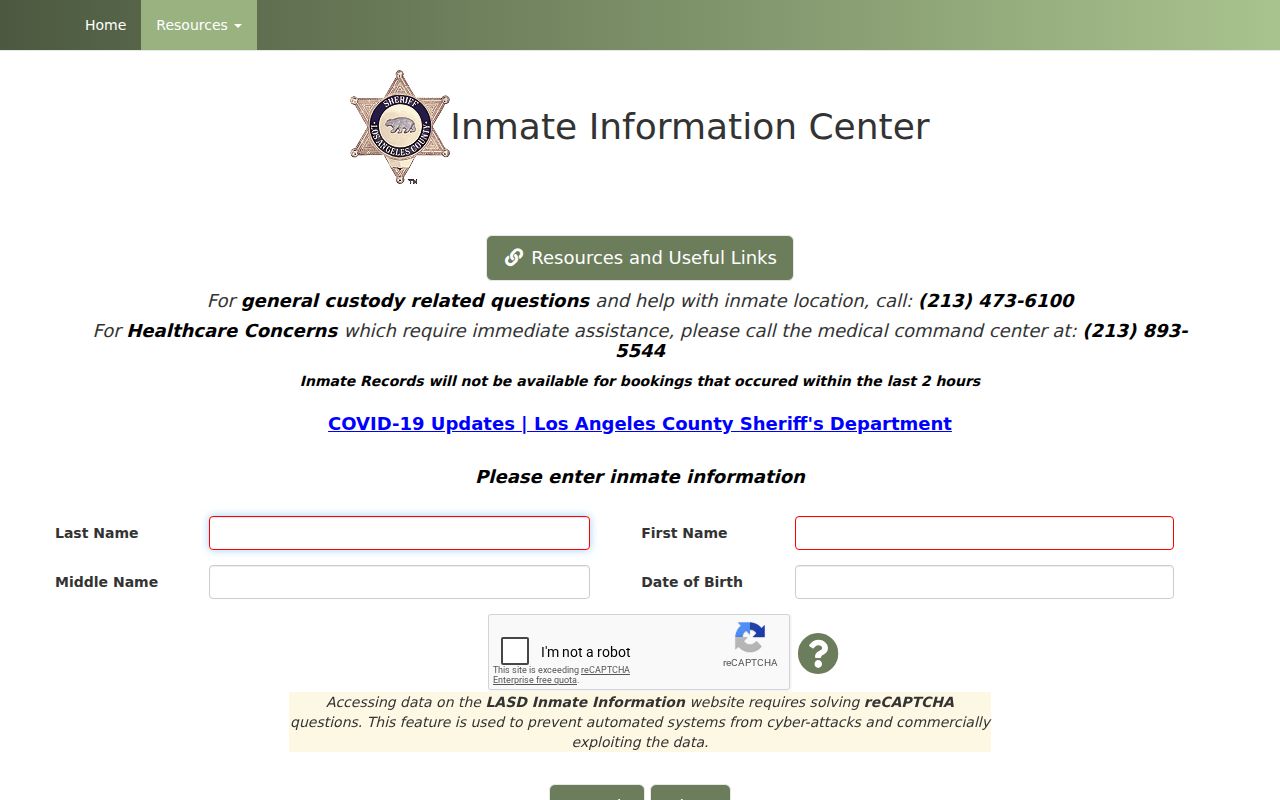
The image belongs to the custody channel, not the previous-residents evidence chain. Deeds, directories, census schedules, permits, obituaries, and probate remain the sources for house history.
The 1887 Townsite Explains Claremont Gaps
Claremont was laid out after the Santa Fe route opened, and the Pacific Land Improvement Company mapped a railroad town in 1887. An 1888 brochure map survives through Claremont Heritage, while Pomona College’s 1888 move joins early land and college archives.
When a current parcel lacks an early address, compare townsite, tract, college, citrus, and newspaper records before assuming the land was empty. Postwar growth over citrus land added more than 1,500 residents yearly at the 1960 to 1965 peak in the library narrative, making plats, permits, Assessor effective years, photos, and maps useful bridges.
Preserve the historic label, modern AIN, and record that links them.