
How Claremont Resident Lookup Records Fit Together
Claremont is an incorporated city, but most person-bearing records sit with Los Angeles County or California custodians. A useful record check starts by naming the fact being tested. The Assessor can connect a parcel to an AIN and transfer event, while the Recorder holds the deed. The court index can show a party and case history. A vital record can establish an event only at the access level allowed by law.
| Record | What It Confirms | Where to Search | Access |
|---|---|---|---|
| Parcel and deed | AIN, situs, ownership interest and transfer pointer | LA County Assessor Portal and RR/CC Real Estate Records | Free parcel view; deed copy or counter channel |
| Court case | Party role, case number, dates and available disposition | LA Superior Court case access | Case number free; name search paid |
| Vital record | Birth, death, marriage or dissolution event | CDPH Vital Records or LA RR/CC | Informational or authorized copy rules |
| Voter information | Personal registration status or a permitted file product | LA County election lookup | Self-lookup; file access has a statutory purpose gate |
| Business or license filing | Entity role, license status or public work address | California SOS, RR/CC and DCA lookups | Basic searches are generally free |
| Directory or yearbook | Historical address, occupation or school affiliation | Libraries, archives and college collections | Collection and appointment rules vary |
Match the source to the question, then seek an independent anchor. A deed owner is not automatically a current resident, a court hit is not identity proof, and a business filing gives a role-related address. The strongest Claremont resident lookup pairs a date, place, relationship, or institution with the custodian’s record.
Claremont Court Fields: Free or Paid
The Los Angeles Superior Court offers two starting paths. A known case number can be accessed without the party-name search fee. A name search uses the civil, small claims, family, probate, or criminal index and is fee-based. Verified online coverage includes unlimited civil, family, and probate cases from 1983, limited civil from 1991, and small claims from 1992. Older files may require a courthouse terminal, clerk request, or archive channel.
| Field | How it works |
|---|---|
| Case Number | Required for direct access; use the court format shown by the clerk or prior record. |
| Filing Courthouse | Optional in limited matters where the case number alone is not enough. |
| Party or Participant Name | Paid civil, small claims, family, or probate name search for a person or company. |
| Defendant Name | Paid criminal defendant search with case number, filing date, and available charge or disposition details. |
Sample LA Court result inventory. A party-search result can be read in six layers. Each layer answers a different identity or access question.
- Identity: party or participant name, role, and attorney information when public.
- Placement: case number and filing courthouse or location.
- Substance: case type, register of actions, hearings, disposition, status, and available criminal counts or charges.
- Dates: filing date, event dates, hearing dates, and disposition date.
- Links: calendar access and eligible civil or small-claims document images.
- Restricted fields: juvenile, sealed, confidential adoption, mental-health, family, and criminal material may be excluded or limited remotely.
The court’s fee information separates an index result from an image. Images cost $1 per page for pages one through five, then $0.40 per added page, capped at $40 per document. Criminal and family documents are not generally remote images. Public terminals and clerk copies remain important when the web path is narrow.
For the fee rules behind a Claremont resident lookup, use the Los Angeles court access and fee page. The screen ties a party search to California Rule of Court 2.506 and Government Code section 68150.
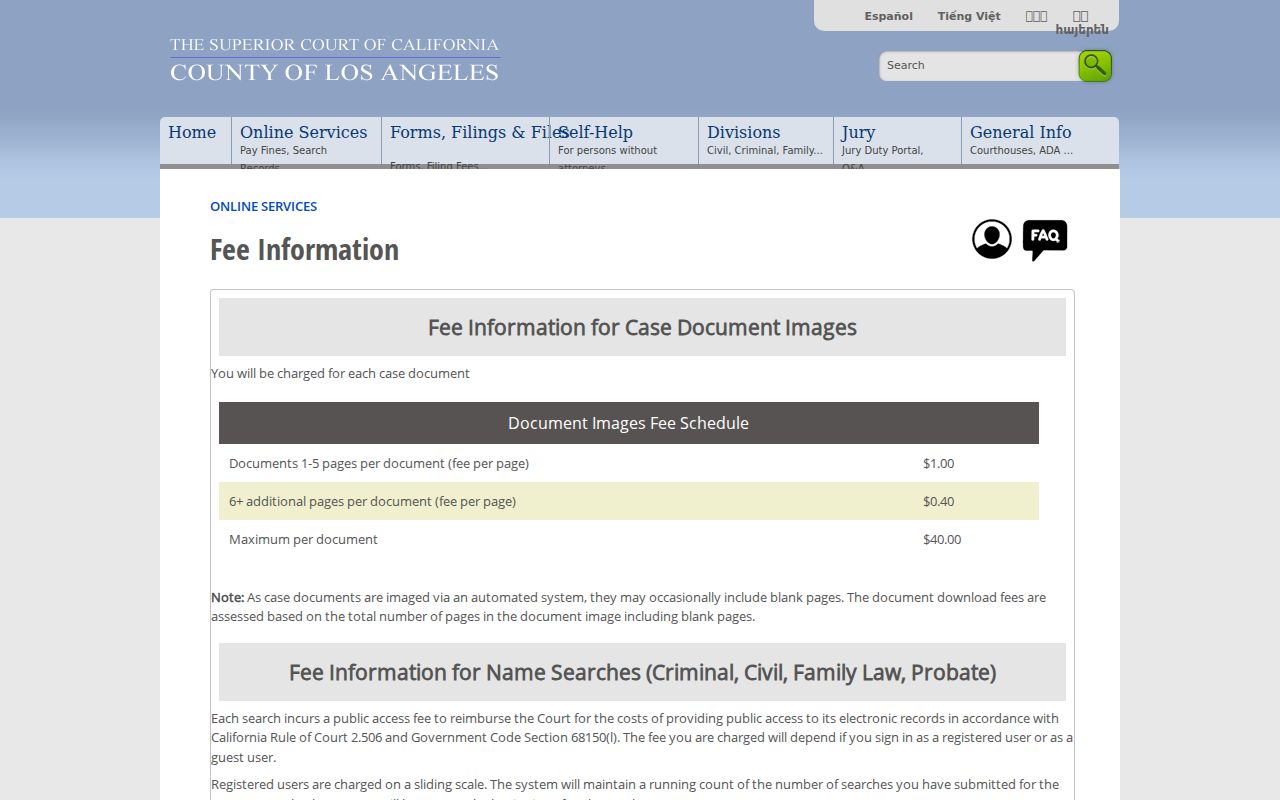
The court fee display is a reminder to identify the cheapest useful path first. If a case number is known, start there; if only a name is known, budget for the paid index and verify the result.
The PACER federal court source represents a separate Central District of California path for federal dockets and filings.
Federal results should remain labeled as federal records, not blended into the Los Angeles County case index.
Note: A case-number result is cheaper than a party-name search, but it requires a known case number.
Same-Name Controls for Claremont Records
Same-name mistakes are the main reason a name-only search fails. Compare middle initials, spelling, filing courthouse, event dates, attorneys, a related probate matter, and any address that appears in an actual filing. A Claremont location is not enough. Keep a short evidence log with the name variant, record number, date, source, and the fact that the record truly establishes.
Do not merge a court party with a property owner because both names are common. A deed may show a trust, a directory may use an initial, and a college entry may cover one academic year. The match strengthens when two independent facts agree, such as a college affiliation and dated address. Record exact spelling, address type, and case, document, license, or parcel numbers, and leave an unconfirmed link marked as such.
Verifying a Claremont Resident Across Records
A disciplined resident lookup moves from a broad clue to a document with a stable number. Start with a full name and one anchor, such as an old address, spouse, college, business, or age range. Compare sources without treating one record as proof of every fact.
- Anchor the name with a parcel, dated directory entry, school record, or other lawful clue.
- Run the LA Court party or defendant search with spelling variants and save the case number.
- Compare dates and relationships against a vital index or eligible certificate route.
- Check a business or license filing only for the role and public contact it actually labels.
- Order a certified copy from the custodian when a formal proof document is needed.
- Docket
- The court’s running case record, listing filings, events, hearings, and status.
- Index versus image
- An index is a finding aid with names and dates; an image is the underlying filed document when access permits.
- Certified copy
- A custodian-attested copy that carries formal certification, unlike an ordinary scan or an index entry.
Property and voter routes need special care. The Assessor can omit an owner name, and voter records are not a general public name directory. Use the legal access channel that fits the record.
California Vital Copies Have Different Access Levels
Birth, death, marriage, and dissolution records do not share one opening rule. LA RR/CC handles county copies, while CDPH maintains statewide records and forms. Authorized copies are limited to listed requesters or a court order; informational copies are marked as not valid for establishing identity.
| Record | Custodian and access distinction | 2026 state fee |
|---|---|---|
| Birth | RR/CC or CDPH; authorized versus informational certified copy | $31 |
| Death | RR/CC or CDPH; sensitive fields and eligibility vary | $26 |
| Public marriage | RR/CC, with CDPH routes for applicable statewide records | $19 |
| Confidential marriage | County of issuance; parties or court-order route under Family Code sections 509-511 | $19 |
| Dissolution certificate | CDPH abstract for applicable events, separate from the Superior Court judgment | $18 |
Use the current California vital-record form index for the applicable VS form. Mailed authorized requests can require a sworn statement and notarization. CDPH accepts a U.S. bank check or money order, not cash, and keeps the search fee when it issues a Certificate of No Public Record. County channels can differ.
Timely fee check. California’s 2026 fees took effect January 1, 2026. Confirm the current schedule before mailing a request.
California has no single rule that makes every ordinary certificate public after a set number of years. Historical indexes held by libraries or genealogy institutions are discovery tools, not blanket access to modern certificates.
Heirs, Classmates, and Other Person-Specific Paths
A person-specific search is stronger when the record follows the reason for looking. An heir trail starts with probate, an obituary, and deed vesting. A former classmate is better approached through college yearbooks, catalogs, alumni archives, and a public organization contact.
California’s official adoption-information process and consent-based reunion services govern birth-parent questions. Obituaries can suggest family links, but a death, probate, interment, or deed record should corroborate them. The historical collection details appear in the Claremont city directory path, where academic-year affiliation stays separate from a permanent household.
Business Labels Do Not Prove Residence
Public business and license records can verify a role, a filing date, or a public contact. They cannot turn a business address into a home address. The California Secretary of State bizfile search accepts an entity name or initial filing number and can show status, entity type, agent, principal or mailing address, and filings. LA County fictitious business name records add a DBA trail. The California Department of Consumer Affairs license search can show a license status, issue or expiry information, board, city, and discipline links when the board publishes them.
Read the label beside every address: principal, agent, mailing, office, or service location. A licensed professional may list a public work address. A business agent may use a filing address. Neither fact establishes where a Claremont resident lives. Correct a filing through the Secretary of State, RR/CC, or the relevant licensing board instead of asking a third-party compilation to change it.
The business search screen illustrates an entity lookup, not a resident roll. Keep corporate affiliation and household identity in separate columns in any research notes.
Use a Narrow Records Request as Fallback
When no public search form answers the question, request an existing identifiable record from the custodian. The Claremont City Clerk handles City-created files such as council material, planning cases, building permits, code files, contracts, and campaign filings. The county RR/CC handles deeds, vital records, fictitious business names, and election products. The California Public Records Act, Government Code sections 7920.000 and following, does not require an agency to create a new list or research a person.
- Name the department, record type, parcel or address, subject, and date range.
- Ask for an existing index, file, application, or permit card, not a new dossier.
- Use City Clerk records for City files and RR/CC specialized channels for deeds or certificates.
- Expect a 10-day determination, a possible 14-day extension, free inspection, and copy fees when allowed.
Requests can be submitted through the Claremont public-records route or the RR/CC CPRA route. For a deed copy, use the special real-estate process instead of a general request. A request should preserve privacy by narrowing the record and date range.
Lawful Boundaries for a Claremont Resident Lookup
California voter files are purpose-restricted under Elections Code section 2194. The county self-service tool verifies a person’s own election information, not a public name-and-address search. Safe at Home, under Government Code sections 6205 and following, provides a substitute mailing address and confidential voter registration for qualifying survivors and other protected persons. A missing result may reflect suppression, a move, or the wrong source.
Lawful use. A Claremont resident lookup is for personal, lawful research and family or civic history. California stalking, criminal-threat, identity-theft, and civil-harassment laws apply when records are used to watch, intimidate, or harm a person.
Correct errors with the office that holds the record: the Assessor for parcel facts, the court for docket access, RR/CC or CDPH for certificates, and the Secretary of State or licensing board for filings. Verify a record with its custodian before relying on it, and do not attempt to reverse-engineer a protected address from nearby documents.